
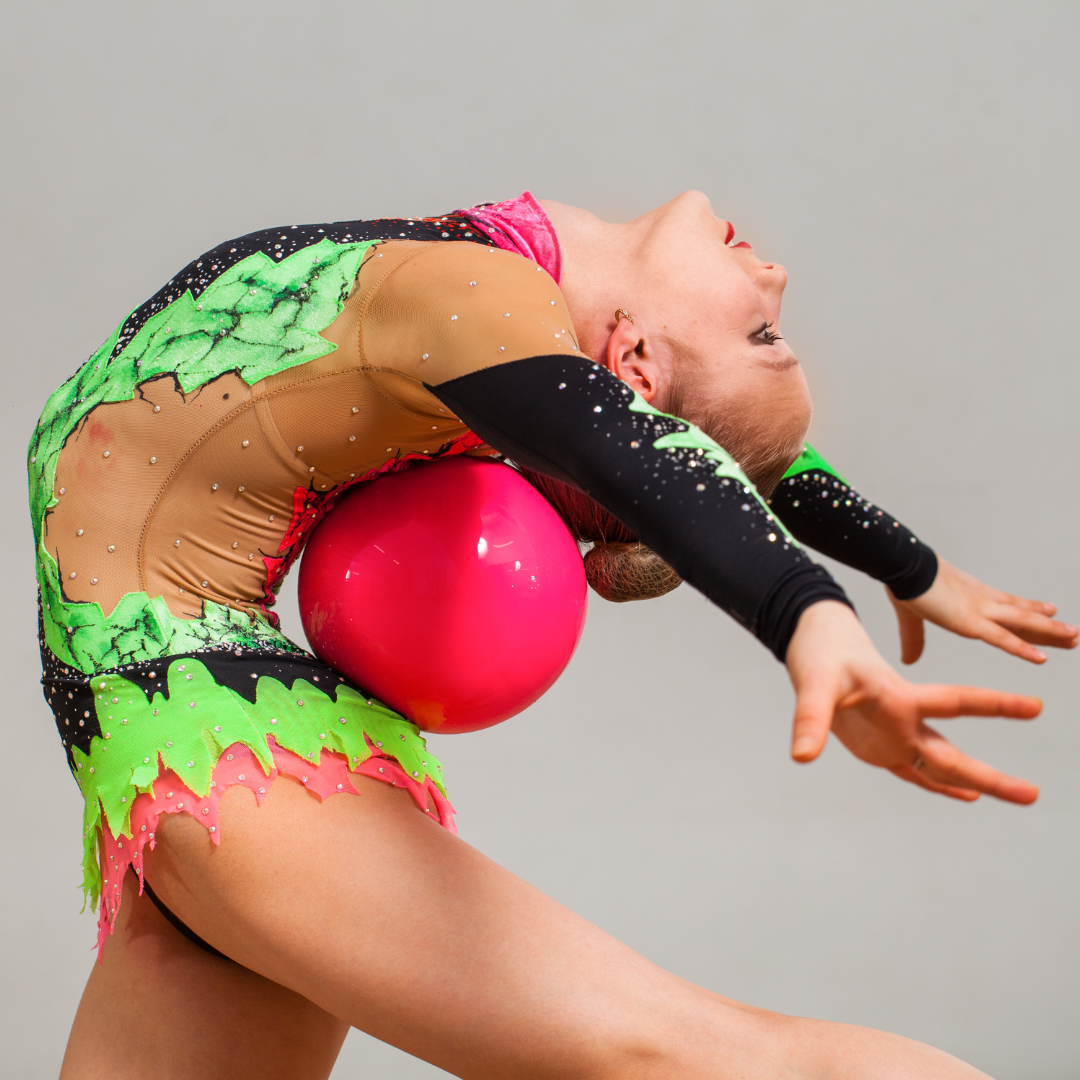
1. Disciplines: individual and group
A basic first distinction in rhythmic gymnastics is between the individual and the group discipline. In individual, each gymnast performs her own routines with the apparatus assigned to her category. In group, a team of (usually) five gymnasts performs in a coordinated way, with apparatus exchanges and synchronisation as its core elements.


2. Age categories and levels
Gymnasts are grouped into categories according to their age and technical level. This determines the difficulty of the routines, the apparatus allowed and the types of competition they can take part in. This organisation is key to ensuring balanced and safe progression, allowing each gymnast to advance at her own pace.
Age categories (Spanish system)
- Prebenjamín (6-7 years): an introductory stage for movement and coordination with adapted apparatus.
- Benjamín (8-9 years): first routines are introduced, with a focus on control and musicality.
- Alevín (10-11 years): routines begin to demand greater precision and technical combinations.
- Infantil (12-13 years): physical and apparatus difficulty increases, and technical fundamentals are consolidated.
- Júnior (14-15 years): the gymnast now performs complete routines with several apparatus and greater artistic demands.
- Sénior (16 years and over): the highest national and international level; competition follows the apparatus and rules of the FIG.
- Primera Categoría: the national elite level, reserved for gymnasts with outstanding senior results or who represent Spain at international events.
Levels or competition programmes
- Predeportiva o Escuelas (Pre-competitive or Schools): a playful, developmental stage with no official scores.
- Iniciación o Promesas (Introductory or Promises): first friendly competitions, with simple routines and an educational focus.
- Base: an intermediate competition level, regulated by the RFEG (Real Federación Española de Gimnasia, the Spanish Gymnastics Federation). Base gymnasts compete in categories similar to the federated ones, but with lower difficulty and without FIG requirements.
- Copa Base y Copa de España: official reference tournaments for this level.
- Absoluto: the full federated level, with routines judged under the FIG Code of Points.
- Primera Categoría: the national elite, where the gymnasts with the greatest technical difficulty and competitive experience compete.
3. The importance of categories in development
Categories are not just organisational. They serve to:
- Promote safe progression: allowing gymnasts to advance step by step, without sudden jumps in difficulty.
- Ensure competitive fairness: making sure those who compete are at similar stages of technical and physical development.
- Enable balanced specialisation: allowing both full training for All-Around and a special focus on individual apparatus.
- Guide coaches and clubs: setting clear goals according to age and level.

4. Official apparatus and its use by category
The apparatus recognised by the FIG for rhythmic gymnastics include: rope, hoop, ball, clubs and ribbon. However, their use varies by category and Olympic cycle. For example:
- In the senior category, rope is no longer used in FIG competitions (for the 2025-2028 cycles). This does not mean that rope is no longer a recognised apparatus, as it remains equivalent to the others.
- In lower categories (infantil, júnior), rope may still appear.
- Some combined apparatus sets (such as group routines with mixed apparatus) are used to increase technical and artistic difficulty, for example 3 apparatus of one type plus 2 of another.
5. Competition formats: All-Around and apparatus finals
- All-Around (General Competition): each gymnast or group performs routines with all the apparatus assigned to their level, and the sum of the scores determines the overall ranking.
- Apparatus finals: after the All-Around, the gymnasts with the best scores on each apparatus qualify for individual finals to compete with that apparatus only.
These formats allow both versatility and specialisation to be assessed in each athlete.
6. Technical regulations and current rules
The technical regulations for rhythmic gymnastics are updated every Olympic period (generally every four years) through the FIG Code of Points, which determines how difficulty, execution and artistic aspects are scored. The technical rules of the Real Federación Española de Gimnasia (RFEG, the Spanish Gymnastics Federation) also set the official categories and rules for national competitions.
7. Frequently asked questions
- Do national categories match international ones? Not always: national federations adapt age ranges and levels to their own circumstances.
- Can a gymnast compete in both individual and group? At higher levels this is uncommon, but some gymnasts may do so during their developmental stages.
- How is a gymnast's category determined? By her year of birth, experience and technical level.
Conclusion
Rhythmic gymnastics is much more than technique and precision. It is a discipline in constant evolution, adapting its rules, apparatus and levels to support each gymnast's growth. From the base categories to senior elite, every stage presents a new challenge and an opportunity to discover the balance between strength, flexibility and artistry.
Understanding each level helps you appreciate the progression of the sport and the work behind every routine. Above all, the important thing is to enjoy the process, celebrate progress and let your passion for rhythmic gymnastics set the pace of your learning.

