
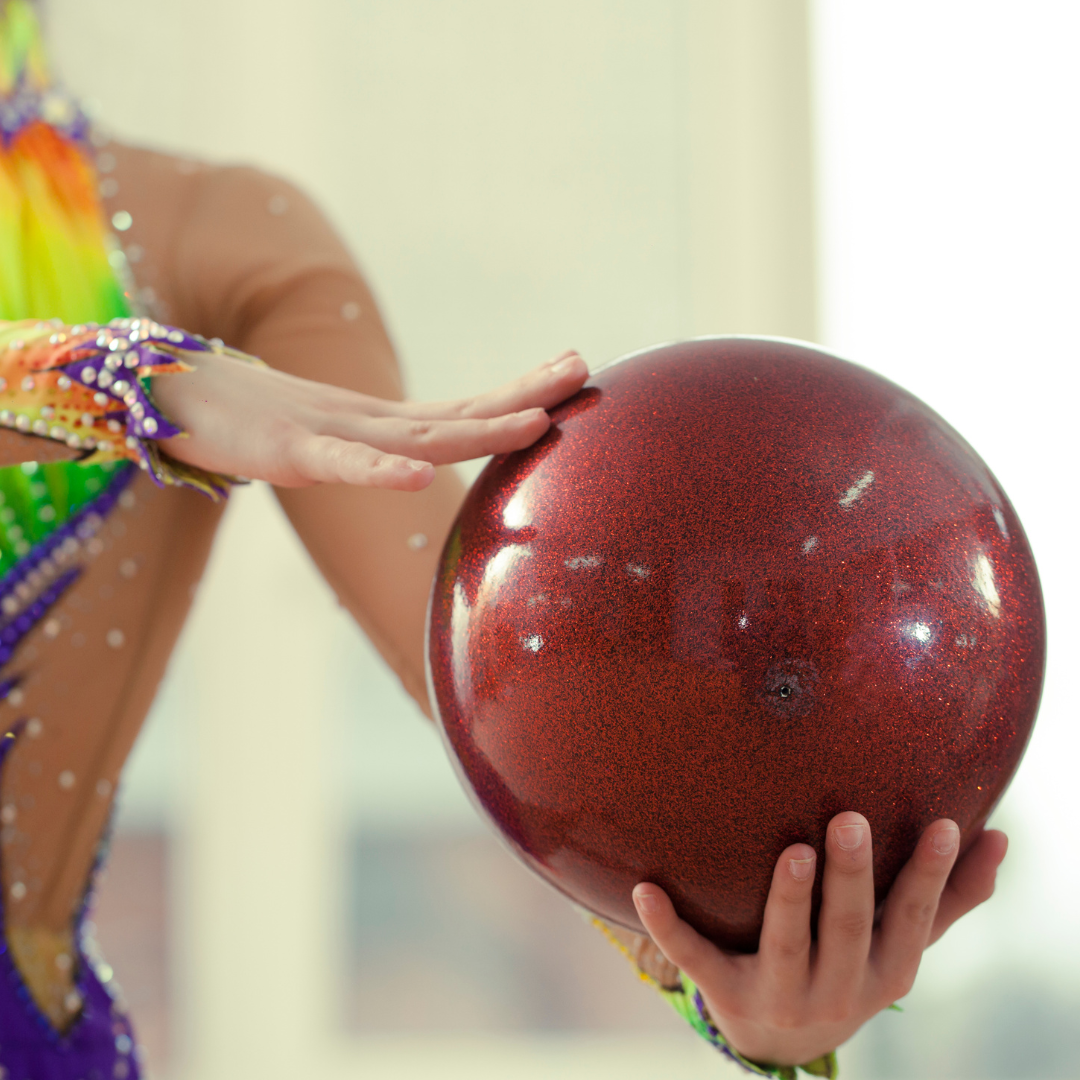
Rhythmic gymnastics is a sport that combines dance, ballet, gymnastics, coordination and apparatus handling. Among them, the ball holds a special place, being one of the first apparatus included in the discipline. Its presence on the carpet not only adds a technical challenge, but also allows the gymnast to express herself artistically with fluidity and harmony through movement.

The ball was introduced into rhythmic gymnastics in the discipline’s early years and has remained relevant over time. Originally, balls were made from simple materials, but as the sport evolved, more flexible rubbers, non-slip surfaces and glossy or glitter finishes were introduced, making the ball easier to grip and adding visual appeal to routines.
Over the years, although other apparatus have emerged, the ball has kept its relevance, evolving in materials and characteristics to meet the growing demands of modern gymnastics.
Which ball is used in rhythmic gymnastics?
For a ball to be considered regulation, it must meet the technical specifications set by the International Gymnastics Federation (FIG). These characteristics ensure fairness in competition and guarantee that the apparatus behaves as expected during the execution of technical elements.
The most important specification is the diameter:
- Adult: 18–20 cm.
- Children’s: 15–17 cm.
These measurements allow the ball to fit naturally in the gymnast’s hand, for smooth and precise handling.
The second crucial factor is weight:
- Adult: ~400 g.
- Children’s: 310–350 g.
Categories and rules vary by country, so check with your national gymnastics federation.
Technique dictates that the ball should not be gripped tightly, but rested on and adapted to the palm of the hand, which is essential for fluid rolls and balances.
The hand must mould to the spherical shape of the ball, allowing it to roll or stay still with precise yet subtle control. The relationship between diameter and weight is key to achieving that sense of naturalness, control and harmony in handling the apparatus.
Fundamental movements with the ball
The technical repertoire with the ball is broad, allowing gymnasts to demonstrate control, flexibility and coordination. Some basic movements include:
- Rolls: The ball moves smoothly over the body or along the floor, always maintaining contact.
- Bounces: The gymnast throws the ball against the floor and catches it on the rebound.
- Rotations: The ball spins on the hand or another part of the body.
- Throws and catches: The ball is thrown into the air and caught in different ways.
- Balances: Holding the ball still on the body while performing complex movements.

Mastering these movements requires constant training and a deep connection with the apparatus.
Choosing the right ball: factors to consider
- Bounce preferences: some gymnasts look for balls with more bounce for throws.
- Weight: others prefer slightly heavier balls within the range for added stability.
- Diameter: even within the regulation range, the size can feel different depending on the gymnast’s hand.
- Material: the tactile feel affects control and precision in complex movements.
- Level and age (children’s or adult size).
- Colour and design: lets you express personal style and match your outfit.
- Trying different balls and brands helps you find the best connection and adaptability.
Ball sizes at Indigo and how to use them
At Indigo Sports we offer three sizes designed for different needs:
Size 15 cm / 280–300 gIdeal for beginners and young gymnasts. Makes it easier to learn throws and rolls.

Perfect for training and competitions at intermediate and advanced level. Ideal balance between weight and manageability.

For older gymnasts looking for more challenge and control in long throws or complex movements.

Each size is available in a range of colours, with or without glitter.
Warnings on the use and care of the ball
- Surfaces: We recommend using it only on carpet, parquet or wood. Avoid asphalt or concrete.
- Storage: Cool, dry places, away from direct sunlight.
- Cleaning: Damp cloth; avoid chemical products that can damage the material.
Ball or balón in rhythmic gymnastics: clearing up the confusion
It’s common for families to search for “rhythmic gymnastics balón” or even “artistic gymnastics ball”. In everyday language, balón and pelota are used almost interchangeably, but in this discipline the apparatus is simply called the ball, and it is the same one we discuss throughout this guide.
Artistic gymnastics is often confused with rhythmic gymnastics too, but the ball belongs to rhythmic, where it is combined with music, dance and expression. If you want to understand how each discipline differs, we explain it in our article on the gymnastics disciplines.
Rhythmic gymnastics ball for kids: where to start
For the youngest gymnasts, what matters isn’t competition, but that the ball feels comfortable and that they enjoy learning. A ball that is too large or heavy makes them squeeze their fingers and lose fluidity, which is exactly the opposite of what we want.
| Size | Who it’s for |
|---|---|
| 15 cm / 280–300 g | Beginners and young gymnasts |
| 17 cm / 350 g | Intermediate and advanced training |
Simple exercises for the first classes
- Rolls along the floor: These help build confidence and get them used to feeling the ball without it slipping away.
- Gentle bounces: Start with one hand and slowly, to work on rhythm.
- Short throws: Small and low, before attempting longer throws.
Remember that the ball should rest on the palm, not be gripped tightly. If you’re not sure what else you’ll need when starting, check out the rhythmic gymnastics materials you need to get started.
If you’re torn between two sizes, the best approach is for the gymnast to try both and see which one keeps her hand relaxed and gives her better control over rolls.
Frequently asked questions
It’s not recommended, as use on hard surfaces can damage the material and affect the bounce.
For young gymnasts, smaller balls (15 cm) or intermediate sizes (17 cm) are recommended, while for more advanced and older gymnasts, sizes between 19 and 20 cm are suitable.
No, it’s purely aesthetic. Glitter balls stand out more in the routine; plain ones are just as functional.
Lighter: it moves quickly in throws.
Heavier: more stable in rolls and balances.
Ideally, try different weights within the regulation range.
Yes, you can choose the colour and finish to match your style or outfit. Personalisation doesn’t affect performance as long as the regulation size and weight are respected.
Yes: material, bounce, texture and grip can vary. Trying different brands helps you find the one that best suits each gymnast.
Yes, it helps improve coordination, balance and control in ballet, dance or body conditioning training. It strengthens arms, wrists and movement precision, and it is popular in Pilates or barre classes.
Conclusion
The rhythmic gymnastics ball is a training companion, a technical challenge and a tool for artistic expression. Knowing its characteristics, sizes and care is essential for any practitioner.
At Indigo Sports, you’ll find sizes, colours and designs created for gymnasts’ comfort, helping every routine feel unique, fun and perfectly suited to different styles.
Now that you know which size you need, find your next rhythmic gymnastics ball among the models available in our collection.

